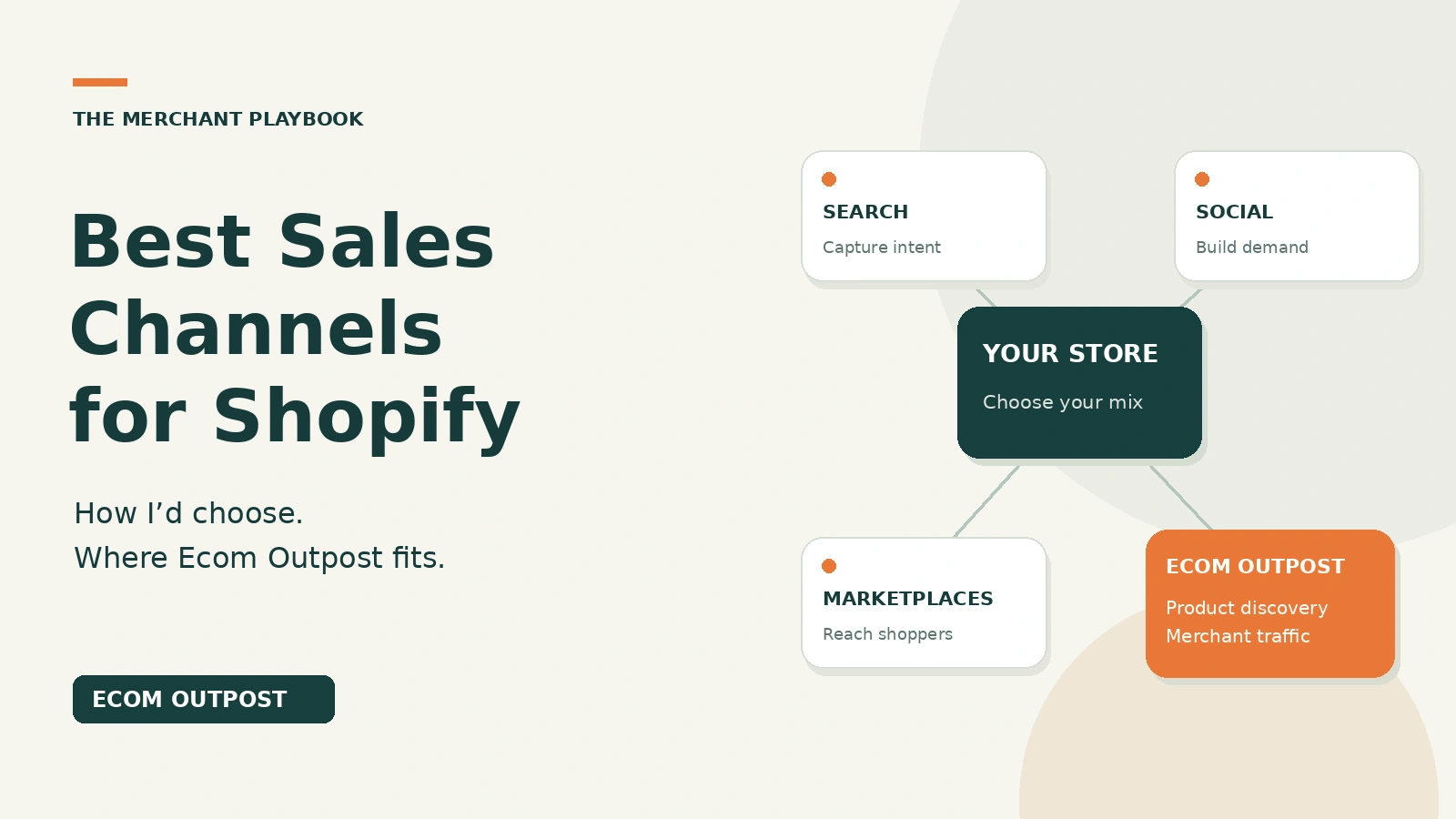
Shopify sales channels are the places you sell beyond your own storefront, connected to Shopify so products, orders and inventory stay in one admin. They don't all do the same job. Some send shoppers to your website to buy (discovery). Some let people buy inside a social app (social selling). Some sell on someone else's site, on their terms (marketplaces). Choosing among them comes down to which trade-off you can live with, and the comparison table below lays the main ones side by side.
Someone could write that Ecom Outpost is the best sales channel for Shopify. I run it, which makes me the last person you should trust on that. So I won't say it. What I will say is that I built it because I wanted a channel like it for my own stores, and I think it earns a spot in a mix. If you want to see how that works, store owners can join here.
First, though, the real question. Which channels deserve your time? That depends on what each one does, and most lists skip that part.
A channel is a door, and doors do different jobs
Shopify describes sales channels as a way to meet shoppers where they're already browsing, and it lists social commerce, Shop, and AI channels among the types. Fine. That's the pitch. The more useful part of Shopify's help pages is a split between two kinds of channel. Traffic-generating channels and order-generating channels are not the same thing. With the first, you place ads or listings and send people back to your store. With the second, your products show up on a platform like TikTok or Temu and the customer buys right there, inside it.
That difference changes everything about how you judge a channel. A traffic channel is a question of cost per visitor and what happens after they land. An order channel is a question of what you give up in exchange for the sale: the checkout, the relationship, often a good chunk of control.
So when someone asks me for the best channel, I ask back: best at what? Sending people to your door, or taking the order somewhere else?
 List your storeon Ecom Outpost
Shopify sales channels compared
Here's the short version of what each channel costs and where the sale actually happens. I've put our own row first and marked it, so you know exactly where the bias is.
| Channel | Type | Best fit | Cost to you | Where checkout happens | Key limitations |
|---|---|---|---|---|---|
| Ecom Outpost (ours) | Discovery | Independent Shopify stores that want to be found without paying for every click | Free (Listed). Catalog $5/mo, Promote $15/mo, Promote Plus $30/mo. No commission | Your Shopify store | New, still growing its audience. Shopify only. Products need Catalog or higher. No guaranteed traffic |
| Google & YouTube | Discovery | Products people search for by name or type | Free channel and free listings where eligible; ads extra | Your website | Merchant Center rules; country and currency limits |
| Discovery | Visual products people save and plan around | Free app and product Pins; ads extra | Your website | Slow to build; needs strong images | |
| Facebook & Instagram | Social selling | Stores with a Meta audience or ad budget | Free for eligible stores; ads extra | Your website (some Meta AI purchases check out in-app) | Eligibility rules; reach mostly comes from ads or an existing audience |
| TikTok Shop | Social selling | Products that sell on video, often with creators | No setup fee. Commission per sale (TikTok lists 6% for most US categories), plus creator commission | Inside TikTok | TikTok owns checkout; fees vary by category, so check Seller Center |
| Shop app | Shopify's shopping app | Shop Pay stores that meet Shop's guidelines | No extra cost to be listed; optional Shop Campaigns charge per sale | Shop app or shop.com, with Shop Pay | Shopify Payments countries only |
| Amazon | Marketplace | Products shoppers already look for on Amazon | $0.99/item or $39.99/mo, plus referral fees (mostly 8–15%) | On Amazon | Amazon owns checkout and the customer; heavy competition |
| eBay | Marketplace | Collectibles, used and one-off items | 13.6% final value fee in most categories, plus $0.30–$0.40 per order | On eBay | Price-driven buyers; eBay's rules apply |
| Walmart Marketplace | Marketplace | Established US sellers with sharp prices and fast shipping | No monthly fee; referral fees mostly 6–15% | On Walmart | US only; approval required |
Fees checked November 20, 2026. They change, so confirm on each official page before you commit. Sources: Shopify on traffic vs. order channels, Google & YouTube, Pinterest for Shopify, Pinterest shopping, Meta on Shops checkout, Shopify on Facebook & Instagram, Shopify on Meta AI checkout, TikTok Shop Seller Center, Shopify on TikTok, Shop channel, Shop Campaigns, Amazon pricing, eBay selling fees, Walmart Marketplace pricing.
If you connect Amazon, eBay or Walmart through Shopify's Marketplace Connect app, that has its own fee: free for the first 50 synced orders a month, then 1% per order, capped at $99 a month (Marketplace Connect).
The discovery rows send shoppers to your website to buy, and so do Facebook and Instagram Shops for now. TikTok Shop, the Shop app and the marketplaces take the order on their side, under their rules. Our row is the first kind, which is the whole point of it. If you want the plan details, see what each Ecom Outpost plan includes. If Google is the row you're weighing, I wrote up how to get your products found in Google search.
Marketplaces are real, and so are their trade-offs
I'm not going to pretend marketplaces don't work. Marketplaces now generate 83.4% of e-commerce GMV globally, according to ECDB, with first-party stores at just 16.6% in 2025. And Amazon claimed 40.5 percent of the market among online retailers in the United States in 2025, per Statista estimates. Shoppers go there. That's the whole point.
I've sold on eBay and Amazon myself, and the thing that stuck with me is simple. I could put a product somewhere shoppers were already looking and get a sale without dragging that customer to my door personally. That doesn't mean selling was effortless. It wasn't. But running a store and running a store somewhere people are already looking are two different jobs, and the second one is easier to get started on.
The cost is that the sale happens on their ground. Their checkout, their rules, their customer relationship. For some products and some owners, that's a fair trade. For others it's a slow way to build a business that belongs to someone else. You have to decide which one you are, and nobody can decide that for you.
The gap nobody fills: discovery for independent stores
Here's the hole I kept staring at. Marketplaces give you shoppers but take the sale. Your own store gives you the sale but no shoppers unless you create them. Ads can create them, at a price, for as long as you keep paying.
What I wanted, and couldn't find, was a place where people go to browse independent stores, find one they'd never heard of, and then buy on that store's own website. That's the idea behind Ecom Outpost. A shopper arrives looking for one thing and might leave having found a store they didn't know existed.
Here's how it works in practice, using only what's true:
- Shoppers find stores and products on Ecom Outpost and click through to buy on your website. You keep your checkout and your customers.
- Stores connect through the Ecom Outpost app for Shopify. Billing goes through Shopify, with no long-term contract.
- Every plan includes a store profile and store search by brand keywords. The Listed plan stops there.
- Products appearing in search and departments needs a plan that includes it, which starts with Catalog. Catalog also brings product-level analytics.
- Promote adds sponsored placements for your products in relevant searches, with impressions and clicks reporting for those placements.
- Promote Plus adds Homepage Spotlight weeks, shared with up to four other stores. There's no commission on your sales on any plan.
What I won't do is promise traffic, rankings, or sales. I can't, and anyone who does is selling you something. I'm not trying to promise effortless sales. I'm trying to make it less difficult for a good independent store to get noticed. That's a smaller claim, and it's the honest one.
I'd also say what it isn't. It doesn't replace your store, and I wouldn't want it to. It's another door. If you want the longer argument for that framing, I wrote about a directory as a second door, not a magic one, and there's a rundown of where to submit your store and what to expect.
How I'd judge any channel, ours included
Forget rankings of channels. Ask these questions instead.
Who owns the customer afterward? If the answer is the platform, price that in. If it's you, that's worth something even when the traffic is slower.
What does it ask of me each week? I've been building the Shopify connection and the onboarding for Ecom Outpost, and I keep returning to one standard. I'm asking someone for their attention, so joining shouldn't feel like taking on another project. Hold every channel to that, including mine. If a channel needs a daily chore to stay alive, count the hours.
Can I see whether it's working? Don't trust how a channel feels. Look for numbers you can read yourself. For organic search I watch Google Search Console impressions and clicks to see whether a store is gaining visibility, and I judge SEO progress from that, not from how the site looks or how many pages it has. Same idea applies anywhere. On our side, store owners can see how many shoppers viewed and clicked their listings on plans that include analytics. If a channel can't show you something like that, be careful.
Do I have to spend before anything happens? I'm not against paid ads. I just don't want spending to stand in for understanding what a channel does and who it helps. Be deliberate about what earns a budget. Try the cheap things first and let the data argue for the expensive ones.
Can I walk away? No long-term contract is a feature. A channel you can leave is a channel you can test without sweating it.
Organic channels take patience, and that's the catch
I should be straight about one thing. Launching a store doesn't guarantee anyone finds it, and a new listing anywhere, mine included, doesn't change that overnight. Organic visibility is slow. I've learned to measure it over weeks, not days, and to stop checking every morning.
That's the real trade with discovery channels versus ads. Ads are fast and rented. Discovery is slower and builds a footprint. Neither is wrong. Which one you pick should depend on how long you can wait and how much cash you can afford to burn while you find out.
If your store already has an audience, such as an email list or people who know your name, lean on that first. I covered this in why the best marketing channels depend on who already knows you. If nobody knows you, a marketplace or a discovery site gives strangers a way to run into you, which a blank storefront can't.
So what's my answer?
If you want one sentence: don't hunt for the single best channel, build a small mix where each piece does a different job.
Use your own store as home base, since that's where checkout and customer data stay yours. Add a marketplace if your product suits it and you're fine with the trade. Add a discovery channel so shoppers who don't know you can still find you without an ad budget behind every click. And before you spend a dollar anywhere, check the basics in what I'd check before spending another dollar.
I'd put Ecom Outpost in that third slot, and I'd say so even if I didn't run it, because it sends shoppers to your site instead of keeping them. If that fits how you want to sell, you can list your store here. If it doesn't, no hard feelings. Pick the channel you can wait out, measure it, and keep the ones that earn their place.